Your body knows
Your subconscious knows your body's blueprint of perfection. It knows how far off you are from that perfection. And it knows knows what it needs to get back there.
I talk to your body to uncover tha answers to all the questions you've been wanting to ask it. I find all of the blocks that are keeping it from healing, all of the imbalances and misalignments that are preventing your body from it's perfect flow.
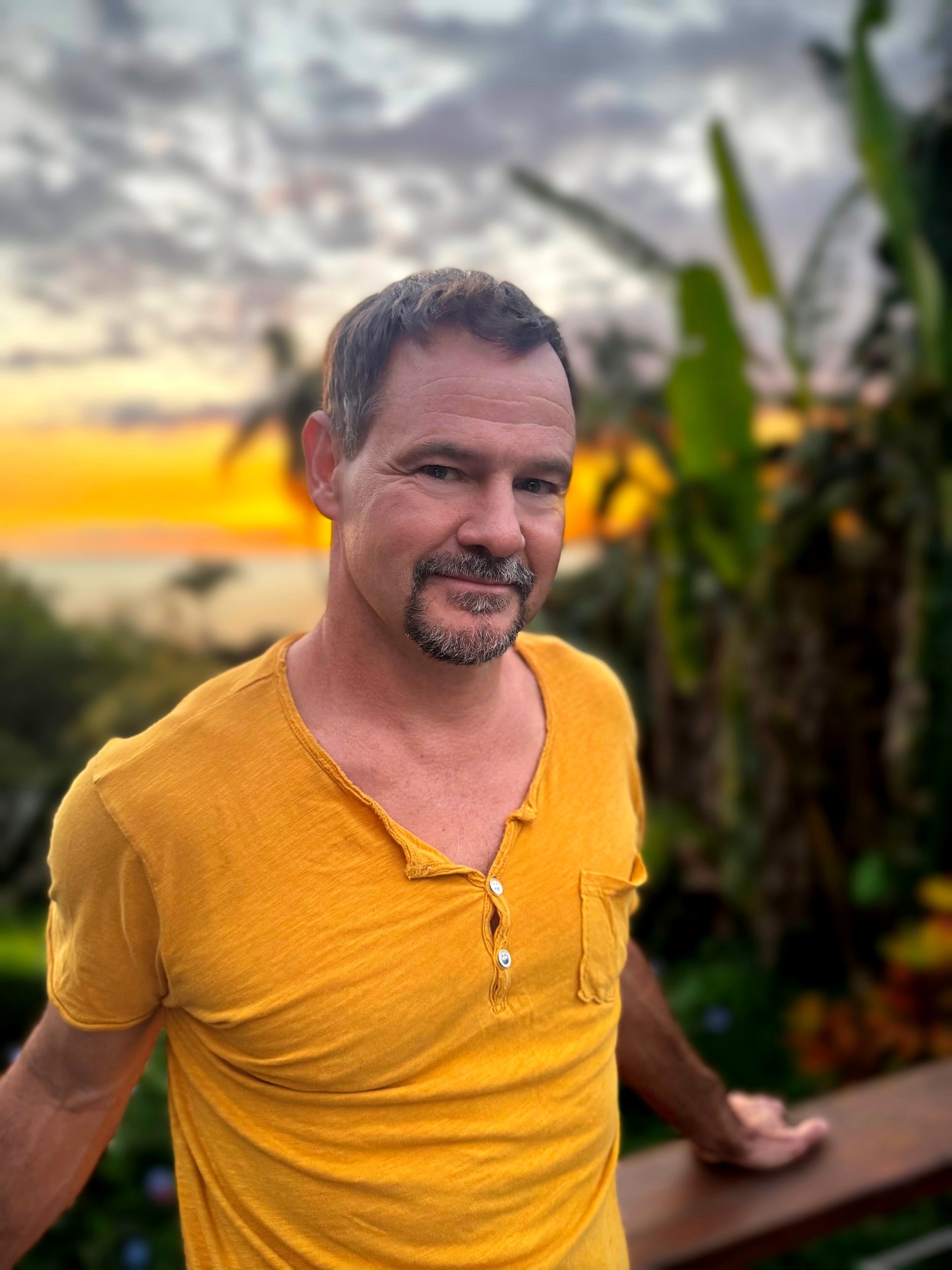
Why I do this work
I believe my dharma — the thing I was actually put here to do — is to help people heal.
That isn't a slogan I picked up along the way. It's the through line of my life. Long before I had language for any of it, I could feel when something was wrong in a room, in a person, in myself. What took me years to learn was that the feeling wasn't a burden to manage. It was the work itself, asking to be used.
Most of the people who come to me are not in crisis. They're functional, capable, and quietly carrying something. A grief they moved past too quickly. An inherited pattern nobody in the family names out loud. A pain in the body that every test comes back clean on. They've usually tried to think their way out of it, and thinking hasn't touched it — because it isn't stored where thinking can reach.
My work is to go find it with them, and then to get out of the way while their body does what it already knows how to do.
How I work
Two things make my practice what it is. The first is applied kinesiology — muscle testing. Done well, it's a conversation with the body rather than an interrogation of it. I've spent years refining my touch with it, learning to feel the difference between a clear response and my own expectation leaning on the answer. That discipline matters. The quality of the work depends entirely on the honesty of the testing.
The second is intuition, which I've learned to trust without letting it run unchecked. Often I'll get a sense of an age, a relationship, a season of someone's life before we've tested for anything. I don't treat that as fact. I treat it as a place to look. Then we test, and the body confirms or it doesn't — and either answer is useful.
Between the two, we usually find the thing faster and more gently than either would alone.
We talk first
What's going on, how long it's been going on, and what you've already tried. Nothing is too vague to start with. "I just don't feel like myself" is a perfectly good place to begin.
We ask the body
Through muscle testing, we narrow down what's being held, where it came from, and how old it is. This is the part that surprises people — how specific it gets, and how often the answer lands with a click of recognition.
We release it
The release itself is quiet and takes moments. Some people feel it immediately — a loosening, a wave of emotion, a long exhale. Others notice the shift over the following days in how they sleep, react, or move.
We let it settle
I'll tell you what came up and what to watch for. Most things need more than one session. I'd rather do this properly over time than promise you a single dramatic afternoon.
Certifications
Trained and certified in all three modalities developed by Dr. Bradley Nelson.
Certified Emotion Code Practitioner
Locating and releasing trapped emotional energy held from past experience.
Certified Body Code Practitioner
A wider system covering structural, nutritional, energetic, toxic and pathogenic imbalance.
Certified Belief Code Practitioner
Mapping and clearing the belief systems built on top of unresolved emotional material.
About Jeremy
Certified practitioner of the Emotion Code, Body Code and Belief Code.
I came to this work the way most practitioners do — by needing it first.
Write a paragraph here about how you found the Emotion Code, what you were dealing with at the time, and what changed for you. This is the part visitors read most carefully, because it tells them whether you understand what they're going through.
Then a paragraph about your training: when you certified, what drew you to add the Body Code and then the Belief Code, and how your practice has grown since.
Then something human that has nothing to do with healing — where you live, your family, what you do on a Saturday. People book sessions with a person, not a modality.
(replace this block)
In practice
Swap these three placeholders for photos — your space, you working with a client, you at a training or certification.
What clients say
Replace this with a real client testimonial. Keep it specific — what they came in with, and what actually changed. Vague praise reads as filler.
A note on testimonials: keep them to descriptions of the person's own experience, and avoid anything that reads as a claim that a condition was cured or treated. That protects both you and them.
The Three Codes
Three connected systems developed by Dr. Bradley Nelson, each one reaching a little further than the last.
The Emotion Code
The foundation
The Emotion Code works from a simple premise: emotions we weren't able to fully process at the time don't simply vanish. They stay with us as what Dr. Nelson calls trapped emotional energy, and they shape how we react, what we avoid, and where we hold tension.
In a session, muscle testing is used to identify a specific trapped emotion — not just "anger," but which anger, from roughly when, and connected to what. Once it's identified and acknowledged, it's released using a magnet or the hand traced along the governing meridian.
The Emotion Code also works with what's described as a Heart-Wall: a protective accumulation of trapped emotion built up around the heart after loss or hurt. Many people describe clearing it as the point where they started to feel like themselves again.
The Body Code
The wider map
The Body Code takes the same testing approach and applies it across a much broader system. Where the Emotion Code focuses on emotional energy, the Body Code works through six categories of potential imbalance: energetic, circuitry, toxicity, pathogens, structural, and nutritional.
Practically, this means that when the emotional thread doesn't fully explain what someone is experiencing, there's somewhere else to look. A session might surface a structural misalignment, a food the body is objecting to, or a disrupted energy circuit — and each has its own approach.
Most of my longer-term client work runs through the Body Code, because it lets us keep going when the picture turns out to be more layered than it first appeared.
The Belief Code
The structures built on top
The Belief Code is the newest of the three, and in my experience it's often where the most durable change happens. Trapped emotions rarely sit alone. Over years, we build conclusions on top of them — I'm not safe being seen. If I rest, everything falls apart. Love gets taken away.
Those beliefs then organise how a person lives, long after the original event is forgotten. The Belief Code maps them as systems: the core belief, the faulty beliefs propping it up, and the negative programs running underneath. Then it clears them in order, from the bottom up.
This is the work I find most moving, because people don't just feel lighter afterward. They make different decisions.
The science, honestly
What's well supported, what's proposed, and where the line between them sits.
I'd rather tell you exactly where this work stands than overstate it. You can make a better decision with an honest picture, and honesty is the only footing I want a healing relationship to start on.
What the research does support
The underlying idea that emotional experience registers in the body is not fringe. It's one of the better-established findings in modern medicine.
Chronic stress measurably alters cortisol regulation, immune function, inflammatory markers, blood pressure and sleep architecture. Large-scale research into adverse childhood experiences has repeatedly linked early emotional trauma to physical health outcomes decades later. Work on the physiology of trauma has shown that unresolved experience is held in the nervous system's baseline settings — in startle response, muscle guarding, and autonomic regulation — rather than only in conscious memory.
The therapeutic relationship itself is also measurable. Across clinical research, the quality of attention, expectation and rapport between practitioner and client produces real physiological change, including in pain perception and immune response. This is usually filed under "placebo," which does the phenomenon a disservice. It isn't nothing happening. It's something happening through a route we don't fully understand.
So: that emotional burden has physical consequences, and that being carefully attended to produces real change, are both well supported.
What is proposed, but not established
The specific framework I work within goes further than the evidence currently does, and it's important to me that you know that.
The idea that discrete emotional energies become trapped in particular locations in the body, that they can be identified through muscle testing, and that they can be released with a magnet along a meridian — these are the propositions of the Emotion Code and Body Code. They have not been validated by controlled clinical trials.
Applied kinesiology deserves a specific mention, because it's central to how I work. When it has been tested under blinded conditions — where neither the practitioner nor the client knows what substance or question is being tested — it has generally not performed better than chance at identifying specific conditions or substances. That's a real finding and I'm not going to pretend otherwise.
Well supported
- Emotional stress produces measurable physiological effects
- Unresolved trauma shows up in nervous system regulation
- Early adversity correlates with later physical health outcomes
- Expectation and therapeutic attention create real, measurable change
- Structured attention to emotional material improves wellbeing by many measures
Proposed, not proven
- Trapped emotional energy as a discrete, locatable phenomenon
- Muscle testing as a reliable diagnostic instrument
- Magnets and meridians as a release mechanism
- Inherited or absorbed emotional energy
- The Heart-Wall as a physical structure
Where that leaves us
I think there are two honest possibilities, and I hold both.
One is that the framework describes something real that our instruments aren't yet built to detect. The history of medicine has a long list of mechanisms that worked before anyone could explain them. The other is that the framework is a language — a structure that lets a person locate, name and finally feel something they've been holding at arm's length, in the presence of someone paying close attention. If that's what it is, it would still be doing real work. Naming a thing precisely is not a small act.
What I can tell you without qualification is what I've watched happen in the room. People arrive carrying something, we find it together, and they leave lighter. I don't need to have settled the mechanism to take that seriously, and neither do you.
My commitment: I will never tell you this can cure a disease, and I will never suggest you stop or delay treatment from your doctor.
How to use this work well
Treat it as complementary, not as a replacement. Keep your physician, your therapist, your medication and your diagnostics exactly where they are. This sits alongside them.
If you're dealing with a diagnosed condition, ongoing pain, or a mental health crisis, please work with a licensed medical or mental health professional. If something you find here surfaces material that feels bigger than a session can hold, I'll tell you so and help you find the right support.
Book a session
Sessions run in person and remotely. Pick a time that works and I'll be in touch to confirm.
Paste your Calendly, Acuity or Square Appointments snippet in place of this block.
Before your first session
You don't need to prepare anything or arrive with a clear account of what's wrong. Most people can't name it — that's usually why they're booking. Come as you are and we'll find the thread together.
Remote sessions work the same way as in-person ones and many clients prefer them, since you can be somewhere you feel comfortable. Set aside somewhere quiet where you won't be interrupted.
Questions first?
If you'd rather talk before booking, email me at hello@jeremywilde.com and tell me a little about what's going on. I read everything myself.
Replace the email address and calendar link above with your own.